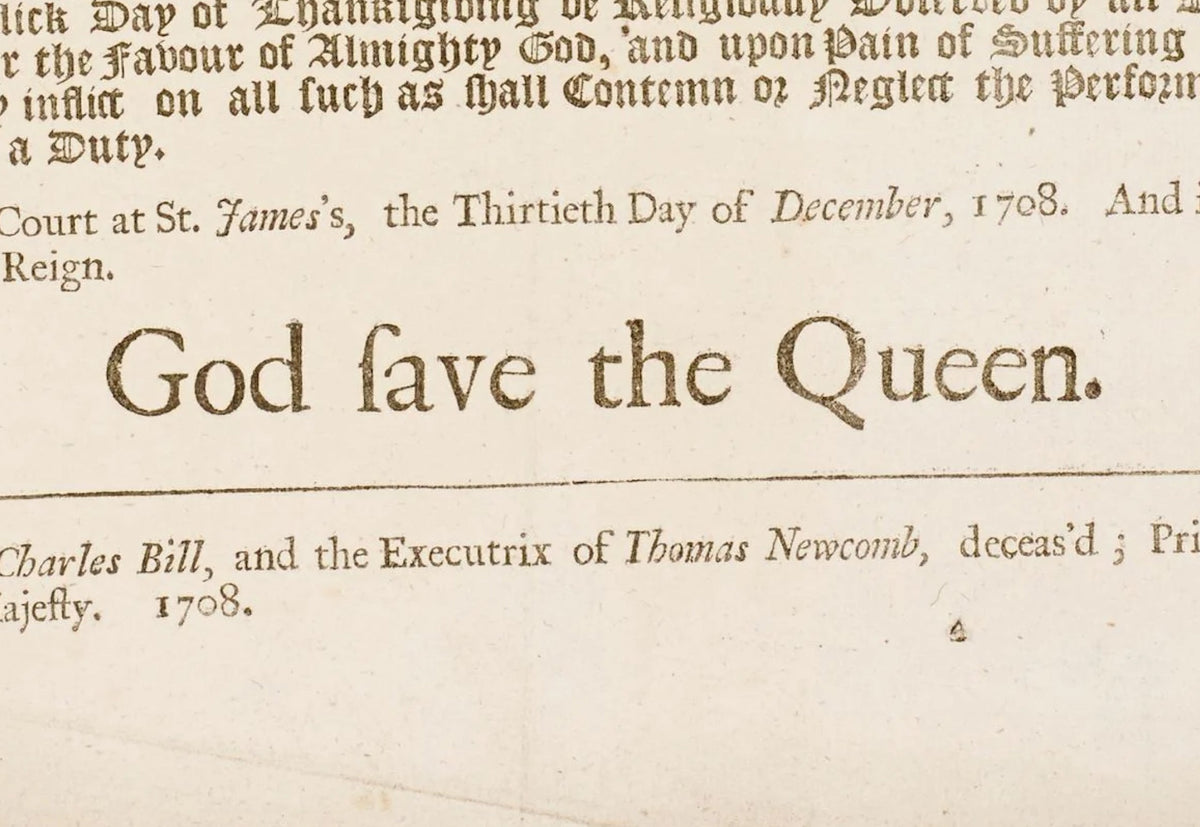
This – ſ – isn’t an f. Look again. It’s actually a ‘long s’, and it has an intriguing backstory, whilst also serving as a reminder of the unarguable – but often conveniently forgotten – flexibility of language, ligatures and letterforms.
To be fair, if you didn’t recognise it, you wouldn’t be the first, and it’s somewhat unfair of an ask in the first place. It is VERY old. In fact, it’s defined as archaic, having been used in latin script since the late 8th century, based on the old Roman cursive medial s. With that in mind, it was never a substitute to the lowercase s as they were both around at the same time. Instead, there were grammatical rules for the two to work together.


History
Latin scripts have historically carried these two shapes, a long form (ſ), descending above the x-height like an f without a full crossbar, and a shorter, round form (s), the one we use today. Rather than a decorative feature, it was derived from handwriting, whereby scribes tended to write a taller, flowing s within a word and saved the closed, round s for the end of a word where the pen naturally finished.

How to use it
When printers mechanised writing into metal, they inherited this two-form system, including both across Roman and italic sets across Europe. With it, came the house rules, if you will, on how exactly to use them.
- Use ſ inside a word, use s at the end.
- “ss” might appear as ſs or ſſ, often fused into a ligature.
- Don’t use ſ in ALL CAPS. It’s a lowercase form.
There was variation by language and printer, but those are the basics. For a full comprehensive guide, check out this wonderfully 2006 blog.

The (not so) long lost OG
What’s interesting is how, due to our indoctrination into our current contemporary approach to grammar and ligatures, we immediately read a long s as an f, which is surprising, given its precedence in literature before the 19th century (for our American friends, it’s even in the OG Bill of Rights). It fell out of fashion, especially in Western Europe, by the late 1700s, as a result of a number of factors, primarily due to the new approach to print. With rising literacy and denser newspapers, the long s’s resemblance to f proved complicated in tighter editorial columns, making legibility at smaller sizes a big issue. Similarly, there was a change in handwriting models.

Print follows pen
Roundhand and later scripts trained writers to favour the short s more consistently. Print, in fact, followed pen. Importantly too, the Enlightenment marked a shift in taste. Neoclassical designs prized crisp, simplified forms and an entirely new aesthetic emerged, dropping the ſ to clean up the page.

Still in use
By the early nineteenth century, most English-language printing had standardised on the short s. Germany, however, kept the long s for longer in Fraktur (a style of blackletter), where it ultimately fed into the eszett (ß) which we know today – historically derived from combinations like ſz or ſs.


Moveable language means moveable type
Returning to our earlier point, the long s is a nice reminder of how unfixed language is. What was considered profoundly normal – and ultimately uninteresting – in one era can be a novelty in the next. For designers, it’s also an intriguing case study in contextual design, whereby one character can have two shapes, interchanging contextually. That logic underpins a lot of modern OpenType principles – contextual alternates, language-specific forms, optical sizes etc. It’s always good to look back and learn. Who knows, maybe it’ll have a succeſsful resurgence soon…
Our fonts have alternates!
Most if not all our typefaces have a alternate characters you can try. Check out our Starter Pack or get your free trials and explore them on your own!


